Learning with Space
Written by Emmy Semprun for MSTU 4088 Introduction to the Learning Sciences
Topic: Learning, Identity, Time, and Space
It's interesting how many methods we have come up with to answer the question: where are you? The "problem" of using, communicating, and shaping space and time is well…as old as time.
We use the poles of the planet, the stars, street names, subway stops, themed conference rooms. And all of the epistemic forms we've landed on for communicating this information (e.g., maps, timelines, GPS pathways) are inherently political. We use them to represent a complex world in lower resolution, and in that process of compression, we make decisions about what places, people, and moments stay. Taylor et al. (2018) make this clear when they describe youth using GIS to make their own arguments about their neighborhoods: counter-mapping, essentially, as a way of pushing back against whose version of the city gets to count. Making it clear that the map isn’t neutral and that youth should have a role in creating it.
Where are you? And our affect towards the answer to that question deeply affects our learning.
(Mirroring the methods in Taylor et al., 2018) I started this week's readings in the library stacks (where we might expect reading to happen), continued on the 1 train downtown (where we might expect anything could happen), continued on the train back a bit exhausted from the day and happy from celebrating a close friend, and finished at my desk at home in pajamas. Where I was and what I was carrying emotionally changed how I engaged with the text and what I’m consequently writing now, which is what Taylor et al. (2018) are after when they analyze "pivot places" (Ellsworth, 2005, as cited in Taylor et al., 2018, p. 7); to me, this positions place as more than a backdrop for learning -- it is a co-author.
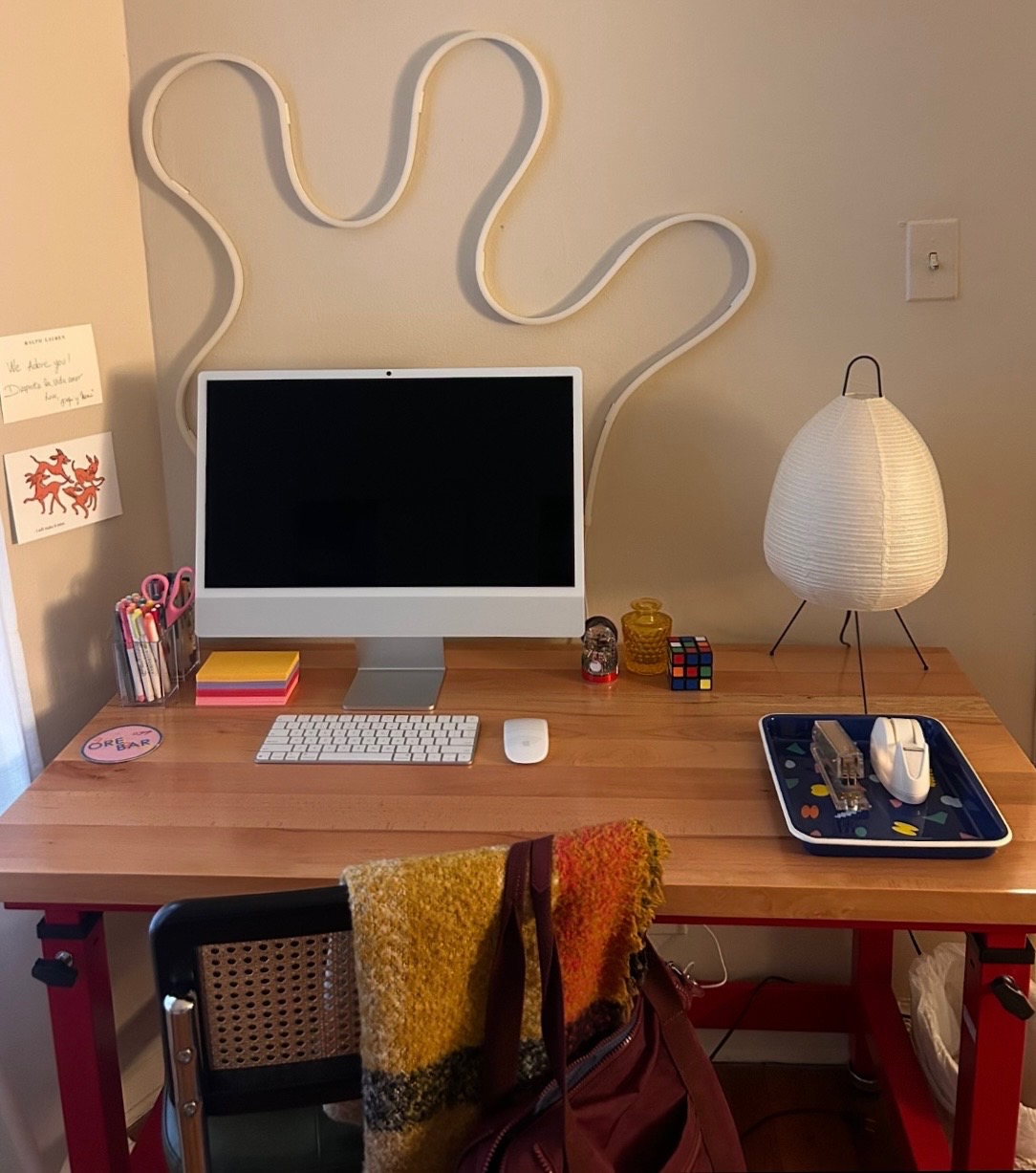
Speaking of my desk, another critical point from these readings was about the design of learning spaces. You can design a space for a specific kind of learning, and that design changes who has agency in the room. The classic comparison is a traditional classroom: desks facing a front board, a design that communicates "sit still and receive" versus a makerspace, where workbenches with paint stains and cut marks say "you should make something here, like others have before!" I recently replaced my desk at home and, after looking at a ton of options, couldn't find one that felt right. Instead of browsing furniture websites, I changed my search method: I asked myself, where do I feel inspired to learn? My answer was makerspaces, so I ordered a workbench, and here I am happily clacking away at this piece.
I especially love the pedagogy of mobility both papers are pointing to (Ma & Munter, 2014; Taylor et al., 2018): it's not just the design of the learning space, but how you move in it. I used to be a horse therapist (no, not therapy for horses, although I'm sure they have their problems too…). I facilitated therapy sessions for children with a diverse range of special needs while they were riding on a horse. Sessions looked really different for each child, but we'd work on things like vocabulary flashcards, or counting balls by moving them from a bucket on one side of the horse to the other. Some of those children were also my peers in high school, and they were completely different people inside a school system not built for them, meant to sit still in the "SPED" classrooms facing the "front" of the room. The act of moving on a horse, outside, with others around them offering physical and cognitive support, gave them access to learning they couldn't reach in traditional classrooms. It always makes me wonder if some "disabilities" are really just a product of what we consider to be learning spaces. It was radical work in terms of movement, space, and learning.
On a separate note: the Taylor et al. (2018) discussion of wearable cameras and how they mediated and regulated youth participation connects back to our DBR week conversation about filming as data collection. We talked about how giving the camera to youth participants is a form of giving them agency, but this paper zooms in on the finer nuances: it matters who the participants are, whether they have a relationship with cameras as surveillance versus self-expression, whether the camera is in their hands or strapped to their bodies, and who they imagine their audience to be. Since that week's discussion and through this week's readings, I’ve been reflecting on a media studio-makerspace hybrid I worked at as an undergraduate, where they made an explicit decision to have high-quality cameras constantly recording around the studio. There were monitors where you could see yourself explaining something, so that a quick intro written on a few cards suddenly felt like a TED Talk. You could read that decision a lot of ways, but in that context, for those students, the cameras communicated: the spotlight is on you, you have agency here. What changes is the spatial, social, and political context the tool lands in. That's maybe the biggest thing both papers are arguing (Ma & Munter, 2014; Taylor et al., 2018): where we situate our design for learning matters; learning doesn't happen in a space, it happens with space.
References
Ma, J. Y., & Munter, C. (2014). The spatial production of learning opportunities in skateboard parks. Mind, Culture, and Activity, 21(3), 238–258. https://doi.org/10.1080/10749039.2014.908219
Taylor, K. H., Silvis, D., & Bell, A. (2018). Dis-placing place-making: How African-American and immigrant youth realize their rights to the city. Learning, Media and Technology. https://doi.org/10.1080/17439884.2018.1526804