
What I Think About When I Think About Football: The Befores and the Afters
One of my earliest memories as a kid is going to a store to buy a football (for the Americans out there: a soccer ball). The first ball I remember being mine was the South Korea–Japan World Cup Fevernova ball 1 (if you know, you know; if not, see Figure 1). Official or not, honestly, I am not sure I could have told you. And even if I could, it wouldn’t have mattered. It was a ball, round, and mine. I carried it to school in a net like a piece of fruit every single morning. The net made it swing against my feet, like a small pendulum that kept time with me. I would leave home and almost immediately begin to tap it forward, catch it with the inside of my foot, let it sway, and kick it again. That, in a nutshell, was play for me.
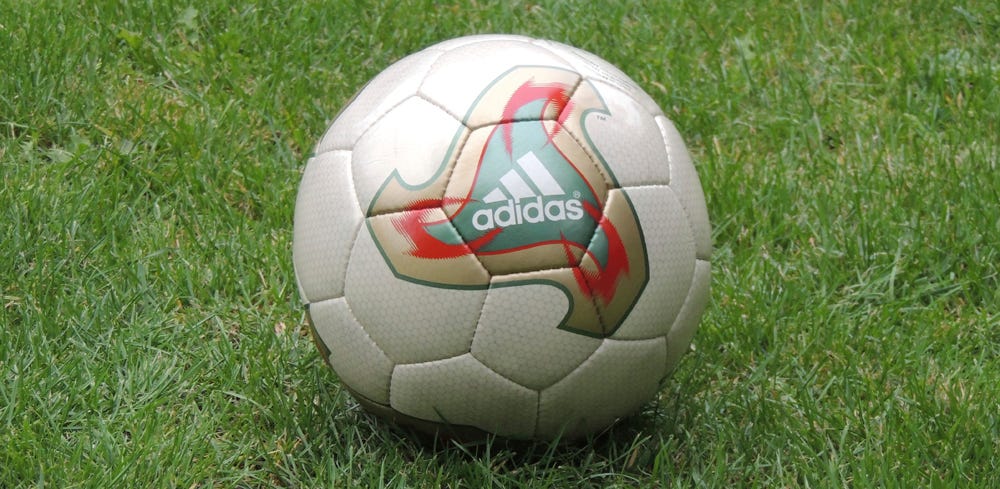
Adidas Fevernova. The official match ball of the 2002 FIFA World Cup in South Korea and Japan
Son of divorced parents, my childhood had a particular geography: between places. The weekly routine of packing and unpacking also left little room for toys. There was always a book, a puzzle of some sort, and, of course, a ball. Full of energy as I was, the ball gave my body a job when my mind had too much time on its hands. Company I could kick forward, catch, and still keep with me. The ball held an immense universe, an odd, endless mystery of edges and textures. But where the ball ended, my play did too.
Maybe that’s why my father decided to sign me up for Kiko Zuñiga’s summer soccer academy. My mother refused outright, claiming she was worried about my asthma, but even at ten, I could tell that what she didn’t want was my father driving me there and back every day during the month of summer that was hers. Custody in my house was more sacred than the Dragon Balls 2 (a show, by the way, I would have spent hours watching alone at home had I not joined the summer academy).
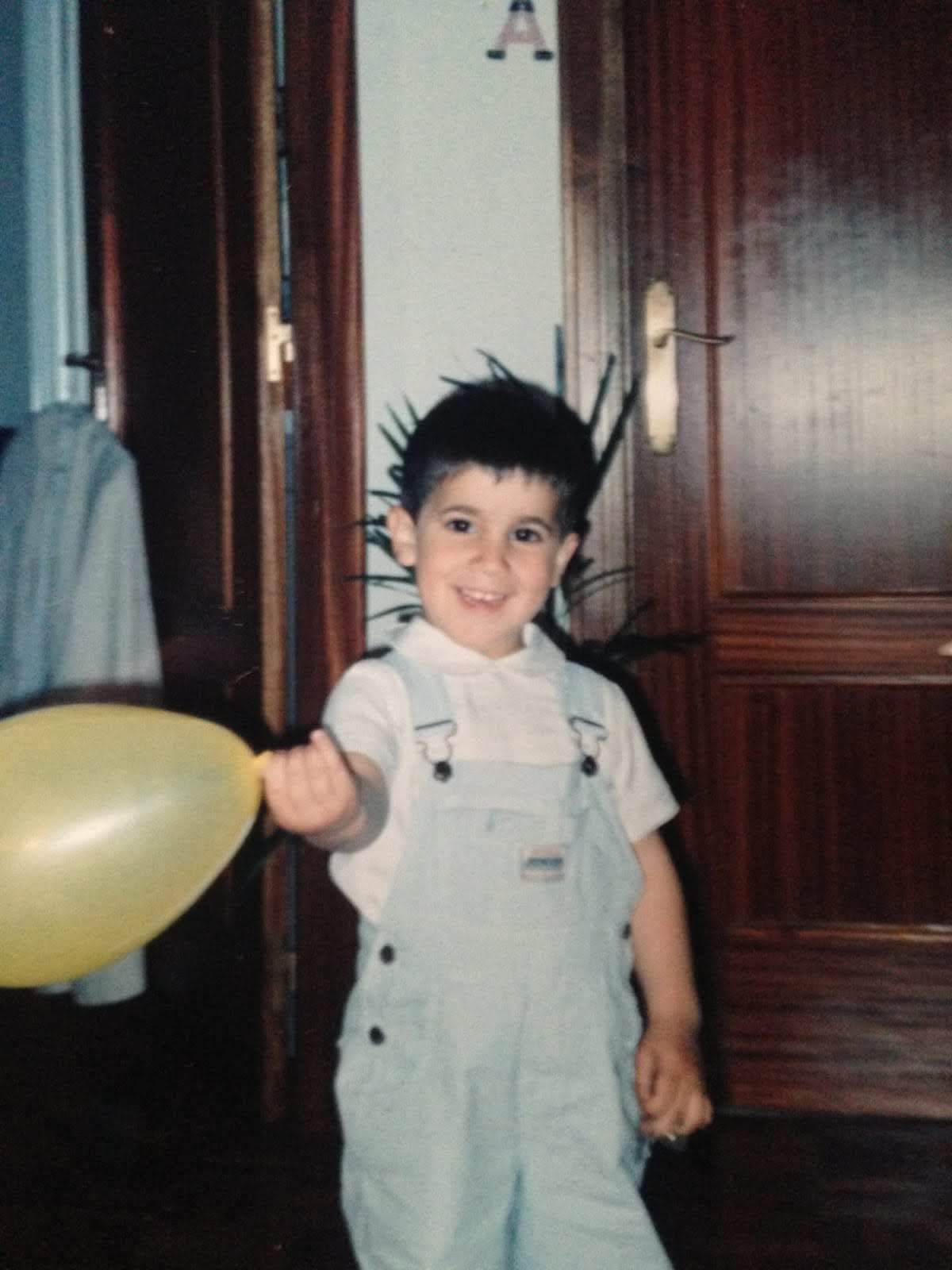
Fortunately for everyone, I was a decently cute kid (proof attached; see Figure 2), and my mother somehow relented and agreed to swap the Dragon Balls for soccer balls and, with that, to let my father be the one to drive me there and back.
I remember the first day as if it were yesterday: “Ready, Jontxu?”
He turned the key of the old green Citroën Xsara, and the CD player came on playing Dire Straits: Sultans of Swing 3 (probably, I would be lying if I said I remember). The guitar bright enough to cut through the morning. 7:30 a.m. on the avenida Ategorrieta, número 7. My dad, smelling of cheap aftershave, already dressed for the office, would arrive late every single day that month, just so he could drive his son to soccer camp. My dad, me, and my ball, round and mine.
I remember the first day as if it were yesterday, yes, and, beyond being absolutely certain I was a happy kid that summer, I remember almost nothing else about my time at the prestigious academy of the great Kiko Zuñiga.
Let me explain: As long as I can remember, my father always tasted like Thursdays and one Friday every two weeks. He never tasted like Mondays or Tuesdays. My time with him was always measured in hours, not in days, and though precious, it never truly felt enough. That is why that summer, what play meant to me ended up having little to do with what happened in between and everything to do with what happened before and after. Spending time with my father that didn’t really “belong” to me became one of the most singular acts of play.
So let’s go back to day one. It’s 7:30 a.m. on the avenida Ategorrieta, número 7, Dire Straits is probably playing (though, again, I would be lying if I said I remember): Mr. Knopfler singing “You check out guitar George, he knows all the chords”. And I knew all the chords too.
This matters, because guessing the artist of my dad’s favorite songs as I got into that car that smelled like Brummel 4 was one of my favorite games. From Loreena McKennitt to Leonard Cohen, from Bob Dylan and Neil Young to Simon & Garfunkel. I knew them all. Names without faces, songs in a then weird language with no obvious meaning to me, but melodies I learned to recognize from a couple of chords and a beat. “Oh, I think I know this one! Go for the next one!”
Another game I would absolutely kick ass at was car brands. I was never especially into cars, but if it was a game, and if it meant the possibility of beating my dad, I was all in. Especially in the morning. We left so early that, as my father used to say, “the streets still hadn’t been put out.” In that half-darkness, he struggled to identify the cars by brand. My ten-year-old eyes were too sharp for him to stand a chance.
By contrast, the order of the towns we drove through from San Sebastián (my hometown) to Ordizia 5 (where the camp was) became, without a doubt, the one my father was best at: Hernani, Andoain, Aduna, Villabona, Anoeta, Tolosa, Alegi, Legorreta, Ikaztegieta, Itsasondo, and… yes, I learned it, dad: Ordizia.
“Well done, son. Now backwards!”
“What?! What are you saying, Aita? 6 That’s impossible.”
I laughed, and he laughed like someone who had been waiting for that laugh for ages.
“Ordizia, Itsasondo, Ikaztegieta, Legorreta…”
“Alright, alright! You’re too good. Let me try…”
I would fail miserably, but whenever I got a short streak right, I would look at him, just a glance, and know he would give me that almost invisible nod, accompanied by that almost invisible smile, that felt like a trophy.
No game was boring. No ride was long enough. They were all silly, spontaneous, and easy to play. My dad mixed the classics with other games he would invent right before picking me up. The last day, when I thought there couldn’t possibly be any more games in my dad’s head, he invented yet another one.
“Today you drive me to the camp.”
“What?”
“Today you take me. I’m still driving, but you… you guide!” he said. “I’m going to turn wherever you tell me. Where should I go? I’ll follow your directions, but hurry up! There’s a stop sign coming….”
There was something absurd about it. Me at ten, guiding a grown-up man through roads he knew way better than I did. I was terrible at my new-hire co-pilot job; we got lost, ended up in a different town, and somehow that ended up being the best part. We pulled over and stopped for a Cola Cao 7 in a bar that smelled like morning coffee and warm milk. The heat of the mug, the spoon clink, my dad by my side, both unconcerned about being late. For the first time, I felt I owned time; at least for as long as a cup of hot chocolate lasts.
On our way back, I watched him with admiration from the distance created by the pedestal I had placed him on during those weeks, as if the invisible bond that had bound me irrevocably to him over the course of that summer were all I needed. For thirty-five minutes, twice a day during my tenth summer, in an old green Citroën Xsara, my father and I found a way to play each other back into existence. That, in a nutshell, was play for me.
Footnotes
- The Adidas Fevernova was the official match ball of the 2002 FIFA World Cup, held in South Korea and Japan. ↩
- The Dragon Balls are the seven wish-granting orbs at the center of Dragon Ball, the Japanese anime and manga franchise created by Akira Toriyama. ↩
- “Sultans of Swing” is a 1978 song by the British band Dire Straits, written and sung by Mark Knopfler. ↩
- Brummel is a Spanish men’s aftershave and cologne brand. ↩
- Ordizia is a town in Gipuzkoa, in the Basque Country, roughly a half-hour drive inland from San Sebastián. ↩
- “Aita” is the Basque word for “father” or “dad.” ↩
- Cola Cao is a Spanish chocolate-flavored drink powder, usually stirred into hot or cold milk. ↩